

5 Essential Table Tennis Footwork Drills for Better Court Coverage 🏓
You know that feeling when you watch a professional table tennis player glide effortlessly around the table, reaching every shot with perfect timing? That’s not magic – it’s exceptional footwork! 🎯 Whether you’re a weekend warrior or aspiring to compete at higher levels, mastering your footwork is the secret sauce that separates good players from great ones.
I’ve been coaching table tennis for over a decade, and I can’t tell you how many times I’ve seen talented players struggle simply because their feet weren’t in the right position. The harsh truth? You can have the most beautiful forehand in the world, but if you can’t get to the ball properly, it’s worthless.

Today, I’m sharing five game-changing footwork drills that will transform your court coverage and take your ping pong skills to the next level. These aren’t just theoretical exercises – they’re battle-tested techniques that I use with players ranging from beginners to national competitors.
Why Footwork Makes or Breaks Your Table Tennis Game 🚀
Before diving into the drills, let’s talk about why footwork is so crucial in table tennis. Unlike tennis or badminton, where you have more time to react, table tennis happens at lightning speed. The ball can travel at over 100 mph, giving you mere milliseconds to position yourself correctly.
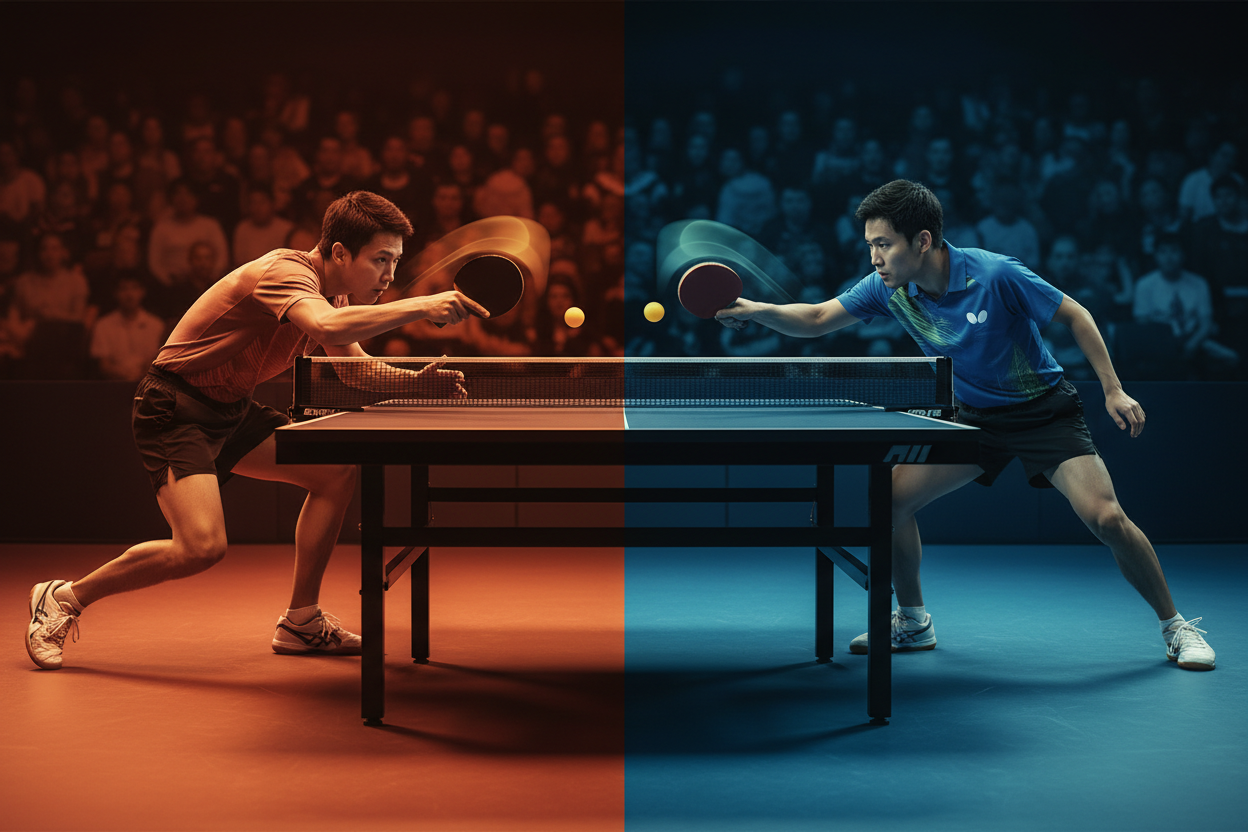
Good footwork isn’t just about moving fast – it’s about moving smart. It’s the foundation that allows you to maintain balance, generate power, and execute shots with precision. When your footwork is on point, everything else falls into place naturally.
I’ve noticed that players who invest time in footwork training see improvements in their game within just a few weeks. Their shots become more consistent, they make fewer unforced errors, and they can handle faster, more aggressive play from opponents.
Drill #1: The Side-to-Side Shuffle 🔄
This is where we start building your lateral movement foundation. The side-to-side shuffle is the bread and butter of table tennis footwork, and mastering it will dramatically improve your ability to handle wide shots.
How to perform the drill:
Start in your ready position about arm’s length from the table. Keep your knees slightly bent, weight on the balls of your feet, and your paddle in a neutral position. Now, shuffle to your forehand side by pushing off with your backhand-side foot, taking small, quick steps. Your feet should never cross over each other – think of it like a basketball defensive slide.
Once you reach the edge of the table, immediately shuffle back to the backhand side using the same technique. The key is maintaining your ready position throughout the entire movement. I tell my students to imagine they’re walking on hot coals – quick, light steps with minimal ground contact time.
Training progression:
Start with 30 seconds of continuous shuffling, focusing on form over speed. As you get comfortable, increase the duration to 60 seconds, then add speed variations. Try shuffling fast for 10 seconds, then slow for 10 seconds, repeating this pattern.
A common mistake I see is players taking steps that are too large, which throws off their balance and timing. Keep those steps short and controlled – you’re not trying to cover maximum distance with each step, but rather maintaining optimal positioning for shot execution.
Drill #2: The Crossover Step Technique ⚡
When the side shuffle isn’t fast enough – and trust me, there will be times when it isn’t – you need the crossover step. This technique allows you to cover more ground quickly when dealing with extremely wide shots or aggressive angles.
The mechanics breakdown:
From your ready position, when you need to move to your forehand side, your backhand-side foot crosses over in front of your forehand-side foot. It sounds simple, but the timing and execution require practice. The crossover should be explosive – you’re essentially launching yourself toward the ball.
After the crossover step, immediately follow with your outside foot to regain your balanced stance. This two-step combination – crossover plus recovery step – should become one fluid motion.
Practice routine:
Set up cones or markers at the corners of the table. Start in the center and practice crossover steps to each corner, focusing on explosive first steps and quick recovery. Do 10 repetitions to each side, then rest for 30 seconds. Repeat for 3-4 sets.
The beauty of the crossover step is that it’s not just about reaching wide balls – it also sets you up perfectly for powerful counter-attacks. When you master this technique, you’ll find yourself turning defensive situations into offensive opportunities. 💪
Drill #3: Forward and Backward Movement Patterns 📐
Here’s something many players overlook: table tennis isn’t just a side-to-side game. Modern playing styles require excellent depth perception and the ability to handle short balls and deep attacks with equal proficiency.
The forward movement drill:
Start in your standard ready position. When moving forward for a short ball, take a small step forward with your playing-side foot (right foot for right-handed players), keeping your body low and balanced. Your non-playing foot follows immediately to maintain your stance width.
The critical point here is staying low. I see too many players standing up as they move forward, which kills their ability to generate topspin and control on short balls. Think of it as moving forward while maintaining a slight crouch.
The backward movement drill:
For deep balls that push you away from the table, the technique reverses. Step back with your non-playing foot first, then follow with your playing foot. This might feel counterintuitive at first, but it maintains your body’s natural alignment for stroke production.
Practice this by having someone feed you alternating short and deep balls. Start with predictable patterns – two short, two deep – then progress to random sequences. The goal is developing the split-second decision-making that separates recreational players from competitive ones.
Drill #4: The Pivot and Recovery System 🌟
This is where footwork gets really interesting! The pivot and recovery system is essential for handling balls hit to your playing elbow (the dreaded “jam” shot) and for transitioning between forehand and backhand shots smoothly.
Understanding the pivot:
When a ball comes to your middle or slightly to your backhand side, but you want to use your forehand, you need to pivot. For right-handed players, this means rotating your body counterclockwise around your right foot, which acts as an anchor point.
The pivot isn’t just a foot movement – your entire body rotates as a unit. Your left foot swings around, your hips turn, and your shoulders follow. It’s like you’re doing a small dance move, but with purpose and precision.
The recovery phase:
After executing your shot, you must quickly return to your ready position. This is where many players lose points – they make a great pivot and hit a fantastic shot, but they’re out of position for the next ball.
Practice the complete sequence: ready position → pivot → shot → recovery → ready position. Start slowly, focusing on smooth transitions between each phase. As you improve, increase the speed while maintaining control.
I like to use a metronome for this drill. Set it to a moderate tempo and practice pivoting and recovering to the beat. It develops rhythm and timing, which are crucial for match situations where you’re under pressure.
Drill #5: Multi-Directional Agility Training 🎪
Real matches don’t follow predictable patterns, so your footwork training shouldn’t either. This final drill combines all the previous movements into a comprehensive agility workout that mimics actual game situations.
The setup:
You’ll need a coach, training partner, or ball machine that can feed balls to different areas of the table unpredictably. If you’re practicing alone, you can create a sequence and follow it, but random feeding is more effective for developing true game-ready footwork.
The execution:
Start in your ready position. Your feeder will send balls to various locations – wide forehand, wide backhand, short to the middle, deep corners, and everything in between. Your job is to use the appropriate footwork technique for each ball and return to your ready position after each shot.
This drill is exhausting, and that’s the point! Match situations are physically demanding, and your footwork needs to remain sharp even when you’re tired. I recommend starting with 30-second intervals with 30-second rest periods, gradually building up to 60-90 second intervals as your fitness improves.
Advanced variations:
Once you’ve mastered the basic multi-directional drill, add these challenging variations: incorporate specific shot requirements (only forehands, only backhands, alternating shots), add time pressure (you must return each ball within a specific timeframe), or include serve return footwork by starting each sequence from a service return position.
Putting It All Together: Your Footwork Training Schedule 📅
Having these drills is great, but knowing how to incorporate them into your regular training is what will actually improve your game. I recommend dedicating 15-20 minutes of every practice session to footwork-specific training.
Here’s a sample weekly schedule that I use with my intermediate players:
Monday & Thursday: Focus on drills #1 and #2 (lateral movement). These are your foundation days – perfect your side shuffles and crossover steps.
Tuesday & Friday: Work on drill #3 (forward/backward movement) combined with drill #4 (pivot and recovery). These complement each other well and develop your three-dimensional court coverage.
Wednesday & Saturday: Multi-directional agility training (drill #5). These are your most challenging sessions – you’re putting everything together under realistic conditions.
Sunday: Active recovery or light footwork review. Maybe just some casual side shuffles while watching table tennis videos online! 😊
Remember, consistency beats intensity. It’s better to do 10 minutes of focused footwork training every day than to do an hour once a week. Your muscle memory develops through repetition, and that repetition needs to be regular.
Common Footwork Mistakes to Avoid ⚠️
After years of coaching, I’ve seen the same mistakes repeated countless times. Here are the big ones that will sabotage your progress if you’re not careful:
Mistake #1: Watching your feet instead of the ball. I get it – when you’re learning new footwork patterns, it’s tempting to look down and check your foot positions. But in table tennis, your eyes must stay on the ball at all times. Practice these drills until the movements become automatic.
Mistake #2: Taking steps that are too large. Bigger isn’t better in table tennis footwork. Small, quick steps give you better balance and allow for last-second adjustments. Large steps commit you to a position and reduce your options.
Mistake #3: Forgetting to return to ready position. Every movement sequence should end with you back in your optimal ready position. It doesn’t matter how perfectly you executed the footwork to reach the ball if you’re out of position for the next shot.
Mistake #4: Practicing only when you feel like it. Footwork improvement requires consistent, deliberate practice. Your brain and muscles need time to develop the neural pathways that make these movements automatic.
Conclusion: Your Journey to Superior Court Coverage 🏆
Mastering table tennis footwork isn’t just about following drills – it’s about developing a movement vocabulary that allows you to express your shot-making ability fully. These five essential drills provide the foundation, but your dedication to consistent practice will determine how far they take you.
I’ve watched players transform their entire game by committing to serious footwork training. Suddenly, balls they used to struggle to reach become routine gets. Shots that used to result in weak returns become opportunities for aggressive attacks. The confidence that comes from knowing you can get to any ball is game-changing.
Start with drill #1 – the side-to-side shuffle – and master it completely before moving on. Quality over quantity, always. As you progress through all five drills, you’ll notice improvements not just in your movement, but in your overall game strategy. When you can cover the court effectively, you can take more risks with your shots, knowing you’ll be able to handle whatever comes back.
Remember, every professional player you admire spent countless hours working on these fundamental movement patterns. There are no shortcuts, but there are smart, efficient ways to train. Use these drills, stay consistent, and watch your table tennis game reach new heights! 🚀
The table is waiting – it’s time to get those feet moving! 🏓
Planet Table Tennis Digital Guides
🎯🏓 For more help in improving your game check out all my digital guides (including free guides) which cover Matchplay, Tactics, Technique, Drills and more.
Click the Learn More button